

Brick Hydro
Three dams of the Isère rebuilt in bricks, so that families can see at a glance what connects a mountain river to a wall socket.
23,089pieces
- Client
- EDF & Maison Bergès
- Sector
- Museum · Industrial heritage
- Exhibition
- Maison Bergès, Villard-Bonnot, France
- Date
- 19 September 2025 – 20 September 2026
- Now at
- EDF Hydro offices, Saint-Martin-le-Vinoux, France
- Pieces
- 23,089 in total
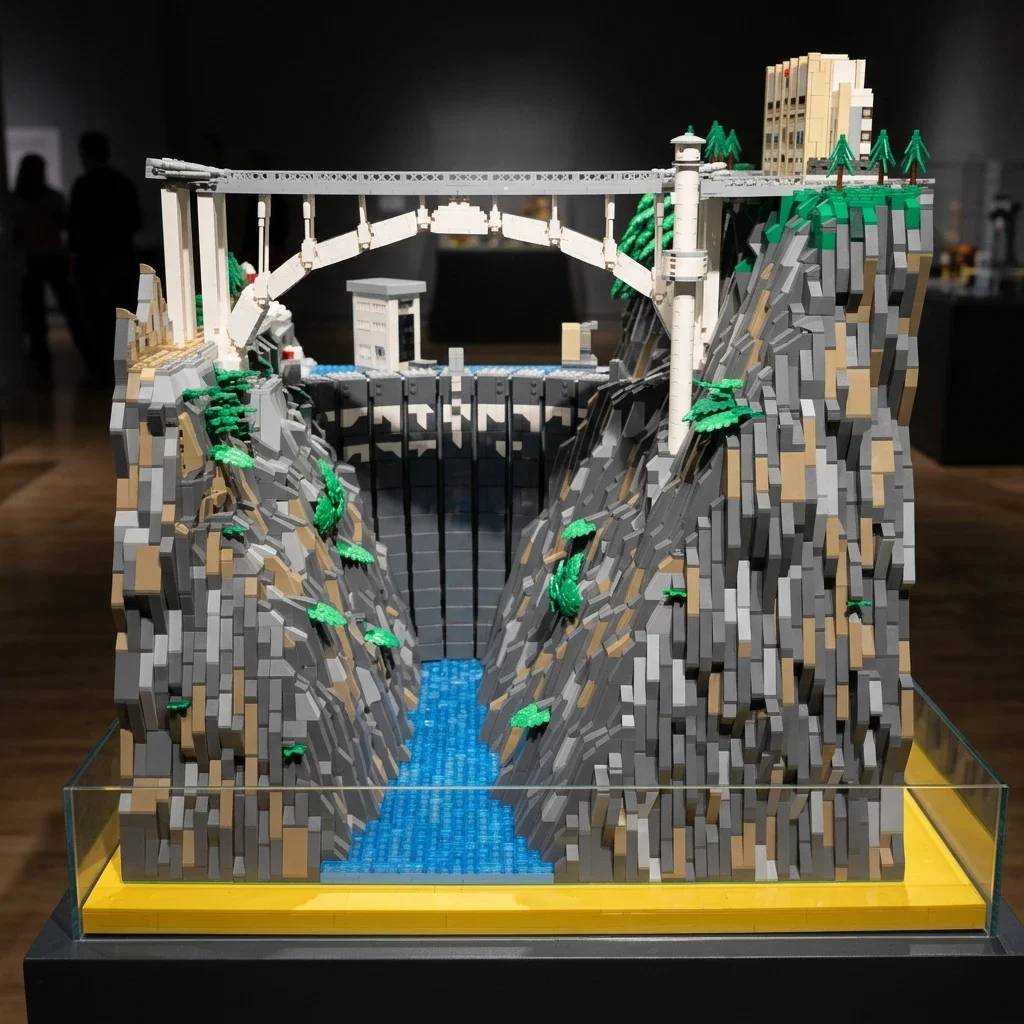
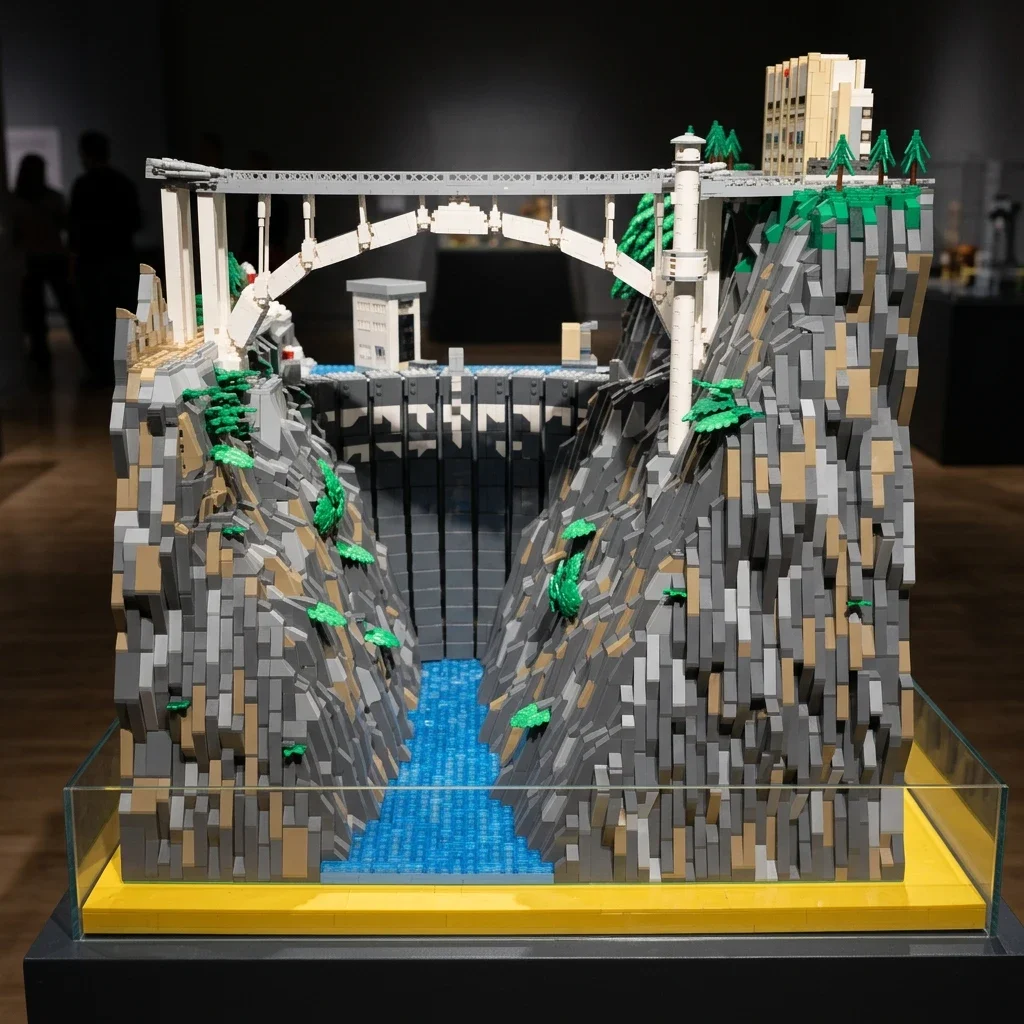
- Le Sautet
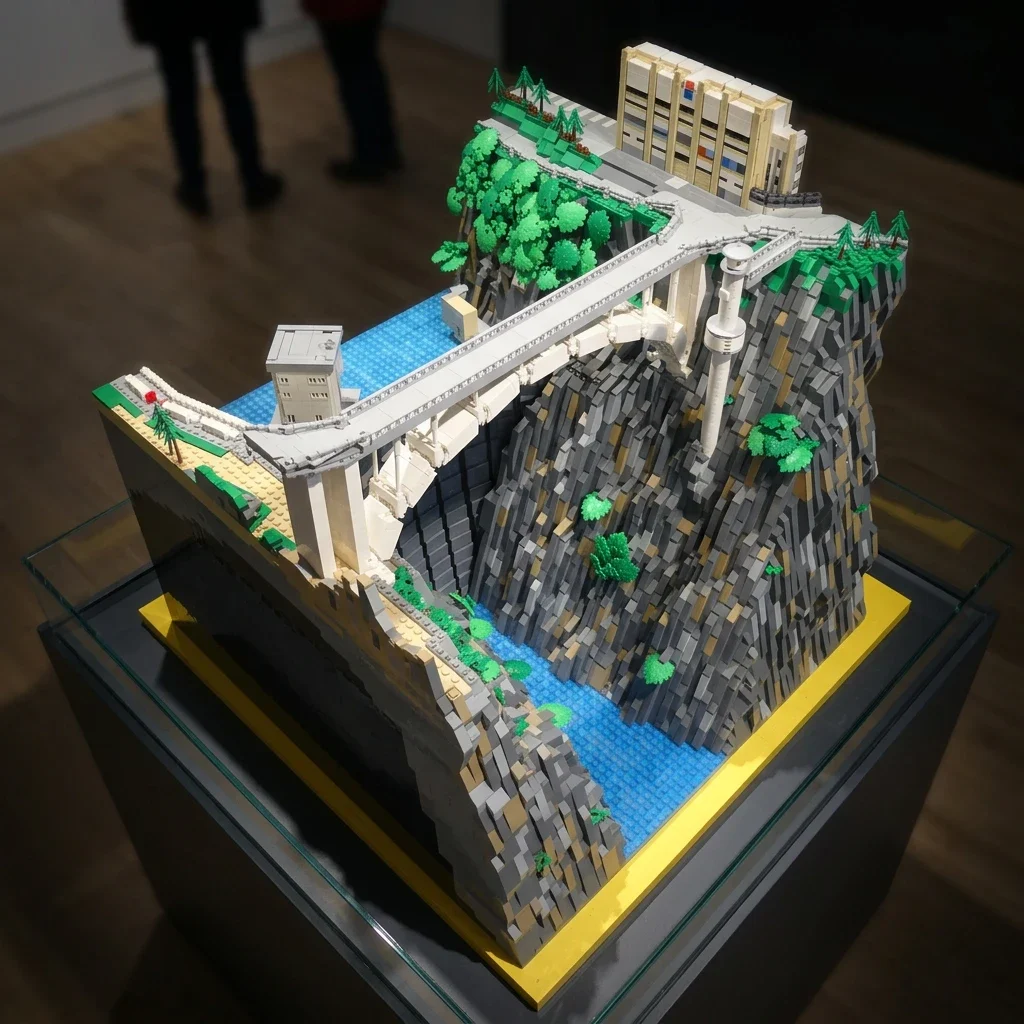
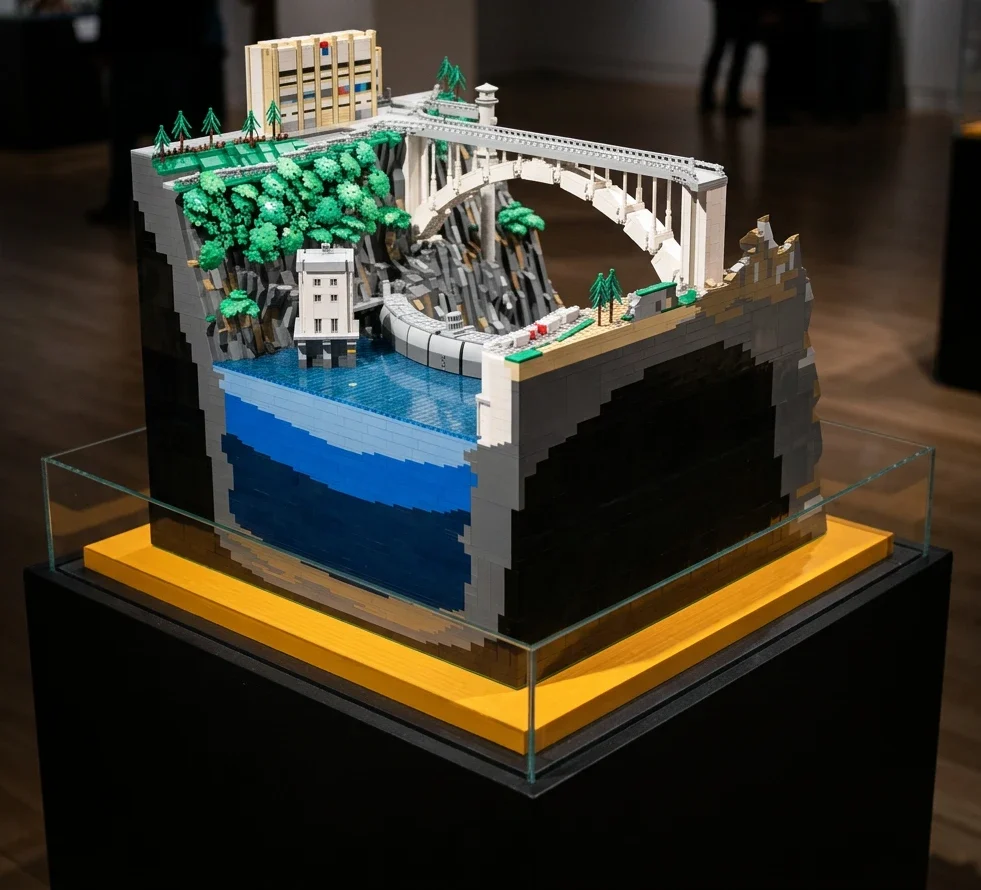
- 9,206 pieces · 52.6 × 52 × 52.2 cm
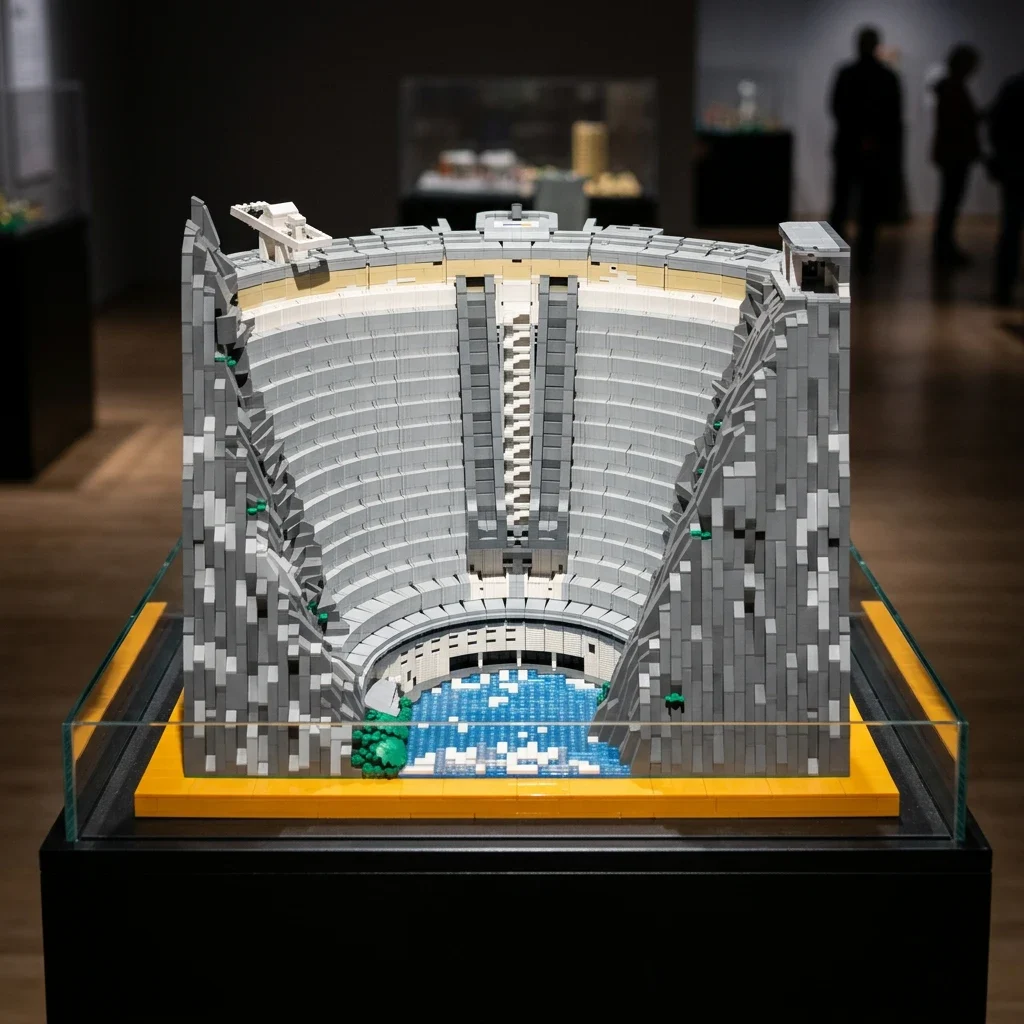
- Monteynard
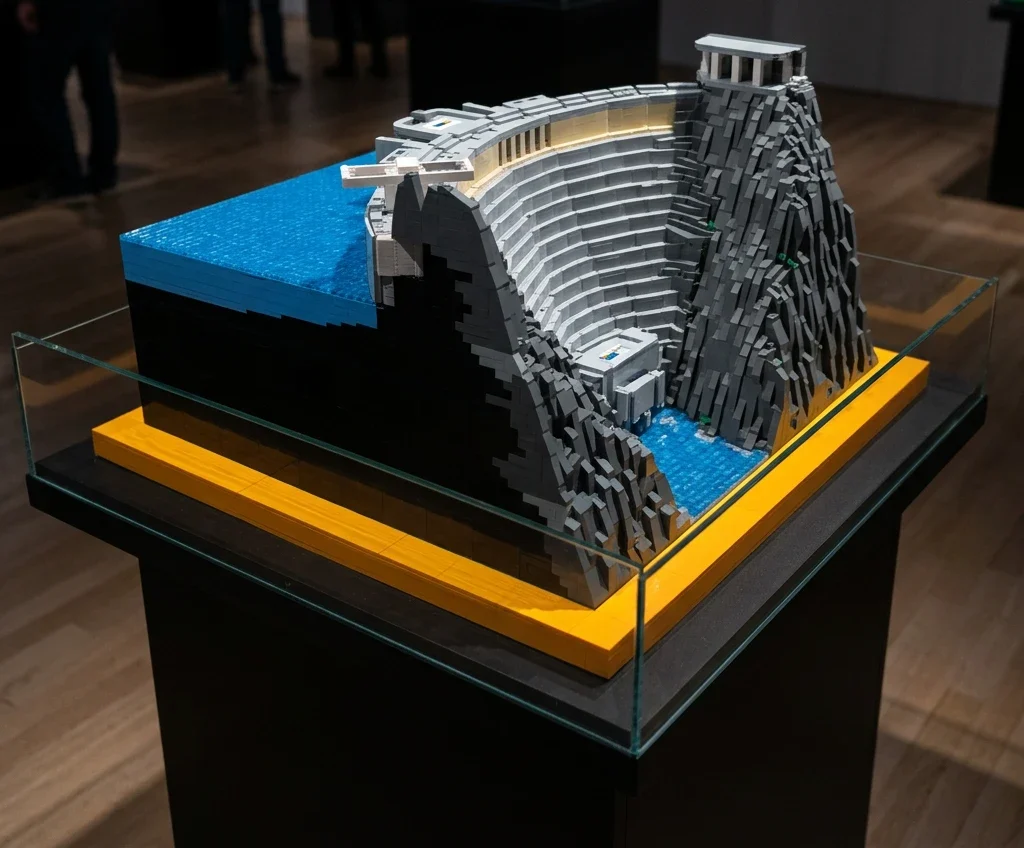
- 8,862 pieces · 52.9 × 52.7 × 39.5 cm
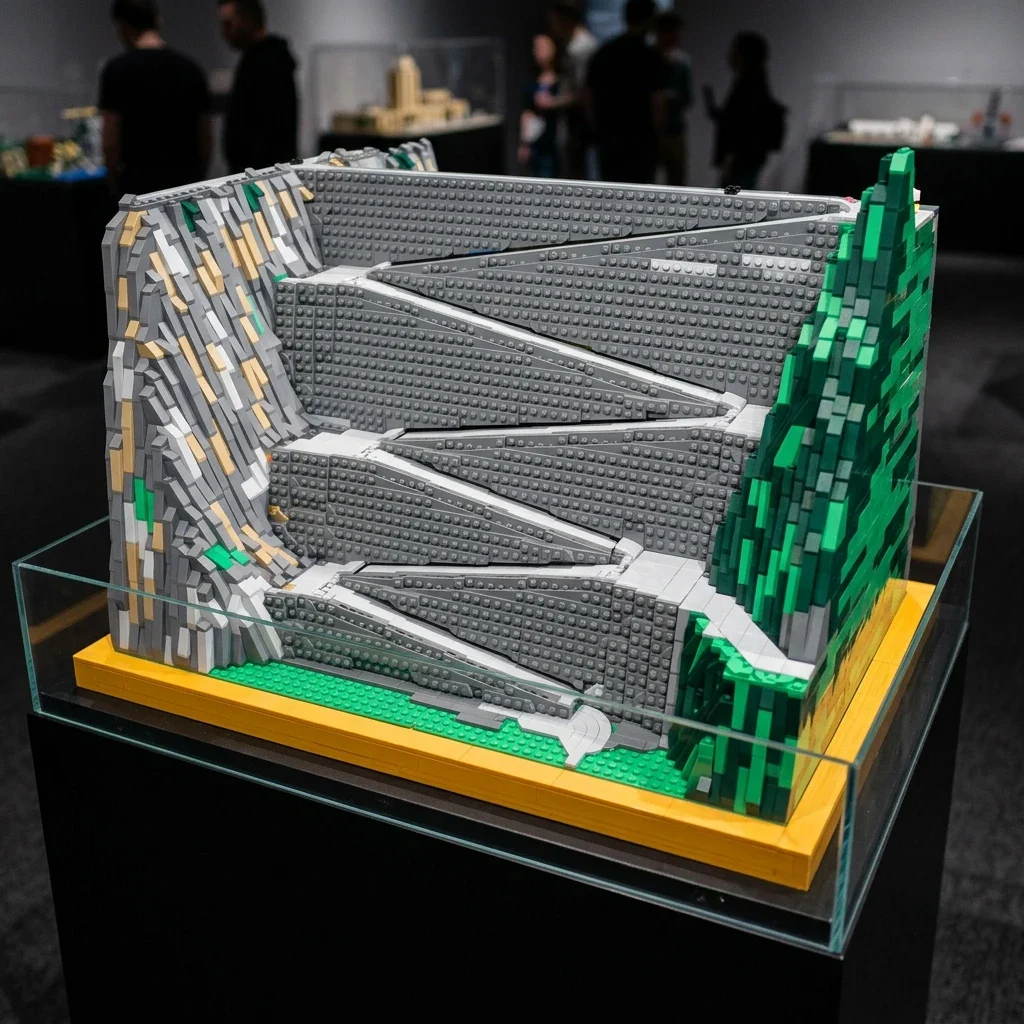
- Grand'Maison
- 5,021 pieces · 52.3 × 51.2 × 35 cm
- Built
- In the workshop
- Scale
- Minifigure
Making visible what nobody ever sees.
An exhibition about hydroelectricity always meets the same obstacle: the subject is invisible. Water comes down, something happens, electricity arrives. In between, a dam, a penstock, a turbine — objects the public never sees, and whose diagrams say nothing to a family out for a Sunday afternoon.
EDF and the Maison Bergès, the museum of la Houille blanche, wanted an exhibition you could walk into knowing nothing: children take an interest of their own accord, parents understand alongside them.
The brick was the obvious material for one simple reason: it makes people want to come closer. You stop in front of a model because it is made of something you have known since childhood, and you stay because you end up reading something in it.
Three dams, three ways of holding back a valley.
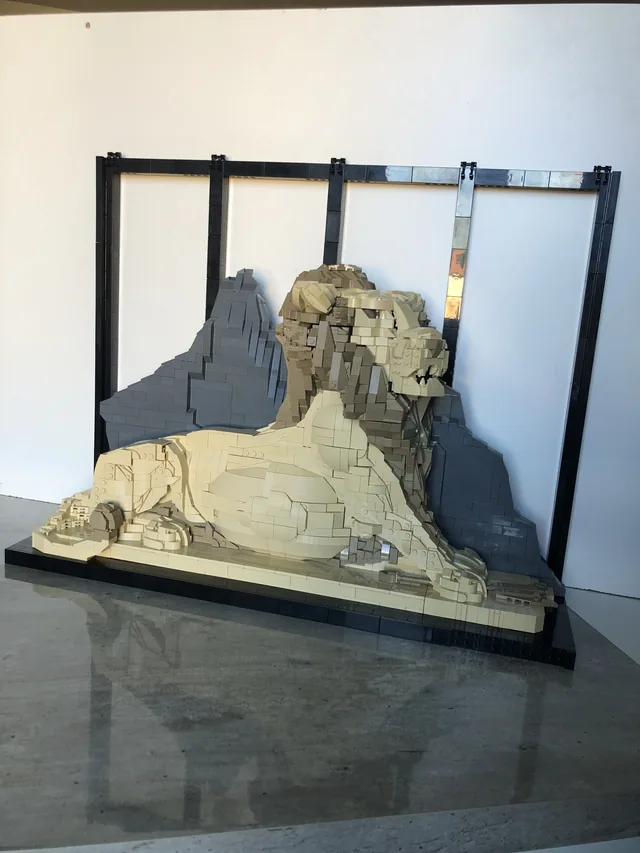
We rebuilt three structures from the Isère that have nothing in common. Le Sautet and Monteynard do hold back the same river, the Drac: the first is wedged into a gorge so narrow that you take it in all at once, with its bridge and its building clinging to the clifftop; the second is seen from downstream, broad and curved, cut by a stairway that runs the full height of the wall. Grand'Maison, on the Eau d'Olle, a tributary of the Romanche, is not a wall at all: it is an entire mountainside, ribbed with white lines that run down to its foot.
Side by side, the three structures say what no caption explains as quickly: there is not one way of holding back water, there are as many as there are valleys.
The landscape matters as much as the structure. A dam on its own means nothing: it is the gorge that gives it its sense, the rock that holds it, the water on one side and the drop on the other. Each model therefore carries its own setting, and visitors see at a glance why the structure takes that shape in that place.
The scale is that of the minifigure, and the choice is not decorative: it gives visitors their measure. In front of an abstract model, nothing tells you whether you are looking at ten metres or two hundred; in front of a silhouette you recognise, the height of the wall becomes immediately legible, and children are the first to do the arithmetic. It is also what lets the landscape enter the case alongside the structure: large enough for the rock to keep its relief and the details to survive — a walkway, a stairway, a gate — small enough for a dam and its valley to fit together inside a square fifty centimetres across.
A year on show, then a second life in the offices.
The three dams were shown to the public at the Maison Bergès, in Villard-Bonnot, from 19 September 2025 to 20 September 2026. An exhibition about energy is often walked through at speed; this one held people, because there was something to look at before there was something to understand. Since then the three models have moved to the offices of EDF Hydro, in Saint-Martin-le-Vinoux, where they now serve the people who do the work.
You have a subject nobody can see.
A process, a structure, an installation your visitors cannot get near. Describe it in three lines.