Architecture, heritage & storytelling

The art of sheer scale.

A building, a monument, an entire city, rebuilt brick by brick. A piece you can walk around, examine closely, point at — and that stops people in their tracks.

Free feasibility study from your plans or photographs.

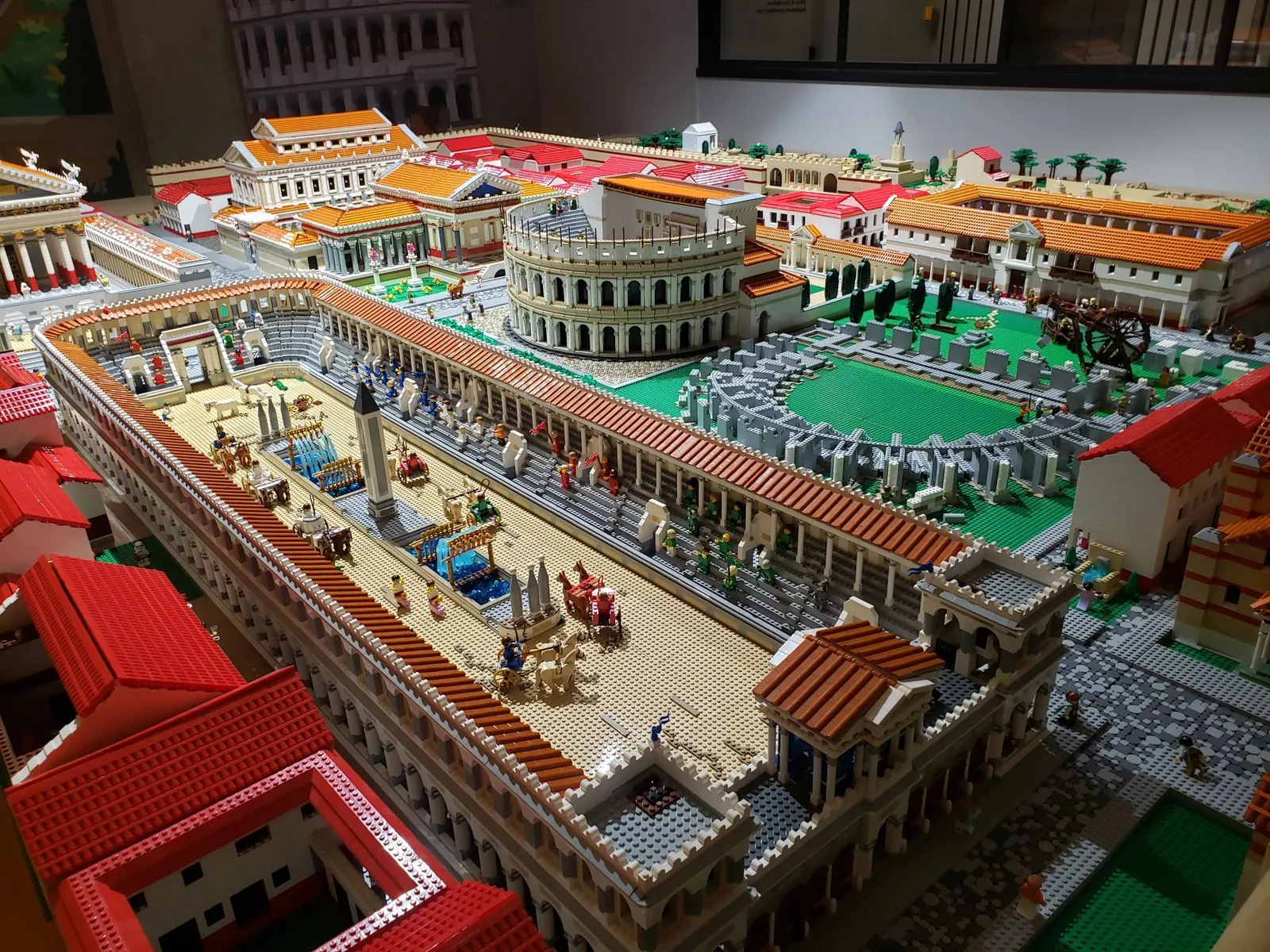
Monumental brick model of the Roman city of Lugdunum
Lugdu'Briques — Lugdunum Museum, Lyon950,000 pieces · 23 m² · 2024
The method

Detail is a question of stock.

The finesse of a model depends less on the hours spent than on the number of different parts available. A cornice, a Roman roof tile, a Corinthian capital: each has its own reference. We hold 118,000 of them in the workshop: if your cornice exists somewhere, it is in our trays.

  • 118,000 references

    Every project draws on a stock sorted piece by piece. When a shape is missing, we go and find it — we don't substitute an approximation.

  • Two scales

    Minifigure scale for detail and inhabitability, micro-scale to take in a whole district at a glance. The choice follows what the piece has to say.

  • Historical accuracy

    On a heritage project, every building is validated against the sources, in dialogue with your curators. The model has to hold up in front of an archaeologist.

  • Designed before it is built

    Everything starts as a digital model. You sign off volume, colours and layout before the first piece is laid.

Find the right kind of model

Two questions, and we'll point you.

Depending on what the piece has to do, it isn't built the same way — or priced the same way.

1

What does your model have to do?

Our formats

Four ways to give an idea volume.

Whether you want to sell a development, explain a territory, tell a story or mark a brand, the piece is not built the same way.

Detailed architectural brick model
Sales & development

Architecture & property

A buyer walking around a model imagines living there. A 3D render on a screen, far less. Sales suite, trade show, head-office lobby or foundation-stone ceremony: the model keeps working long after handover.

Scales
Minifig or micro
Lead time
6 to 14 weeks
Based on
Your plans
Learn more
Historical reconstruction model in bricks displayed in a museum
Interpretation

Heritage & museums

Letting people touch what may not be touched. A model brings a monument down to a child's height, makes a vanished city legible at a glance, and gives access that no display case allows.

References
Lugdunum, Pierre-Noël
Validation
With your curators
Use
Permanent display
Learn more
Farming diorama in bricks on public display
Narrative

Dioramas

A model shows; a diorama tells. An inhabited scene with figures, lighting and a precise moment: the format that explains a farming sector, an industrial process or a historical episode without a line of text.

Format
Case or plinth
Reference
Grand Belfort
Strength
Teaching
Learn more
Technical brick model of an industrial installation
Industry & trade shows

Technical models

A data centre, a transformer, a dam, the fit-out of a truck: what makes your value sits inside a building or behind a panel. A model opens it up and puts it on your stand, where it stops passing traffic better than two hundred screens.

References
Microsoft, EDF, Equans
Lead time
8 to 14 weeks
Confidentiality
NDA before any study
Learn more
Corporate logo built in three dimensions from bricks
Brand

Logos & brand objects

Your logo in three dimensions in the lobby, on an exhibition stand or in a press photograph. An unexpected object that visitors photograph and share without being asked.

Lead time
3 to 8 weeks
Reference
Grundfos
Option
Travel version
Learn more

Every model can become a participatory build: your teams, visitors or partners construct part of the work, supported by our hosts and guided by our digital plans.

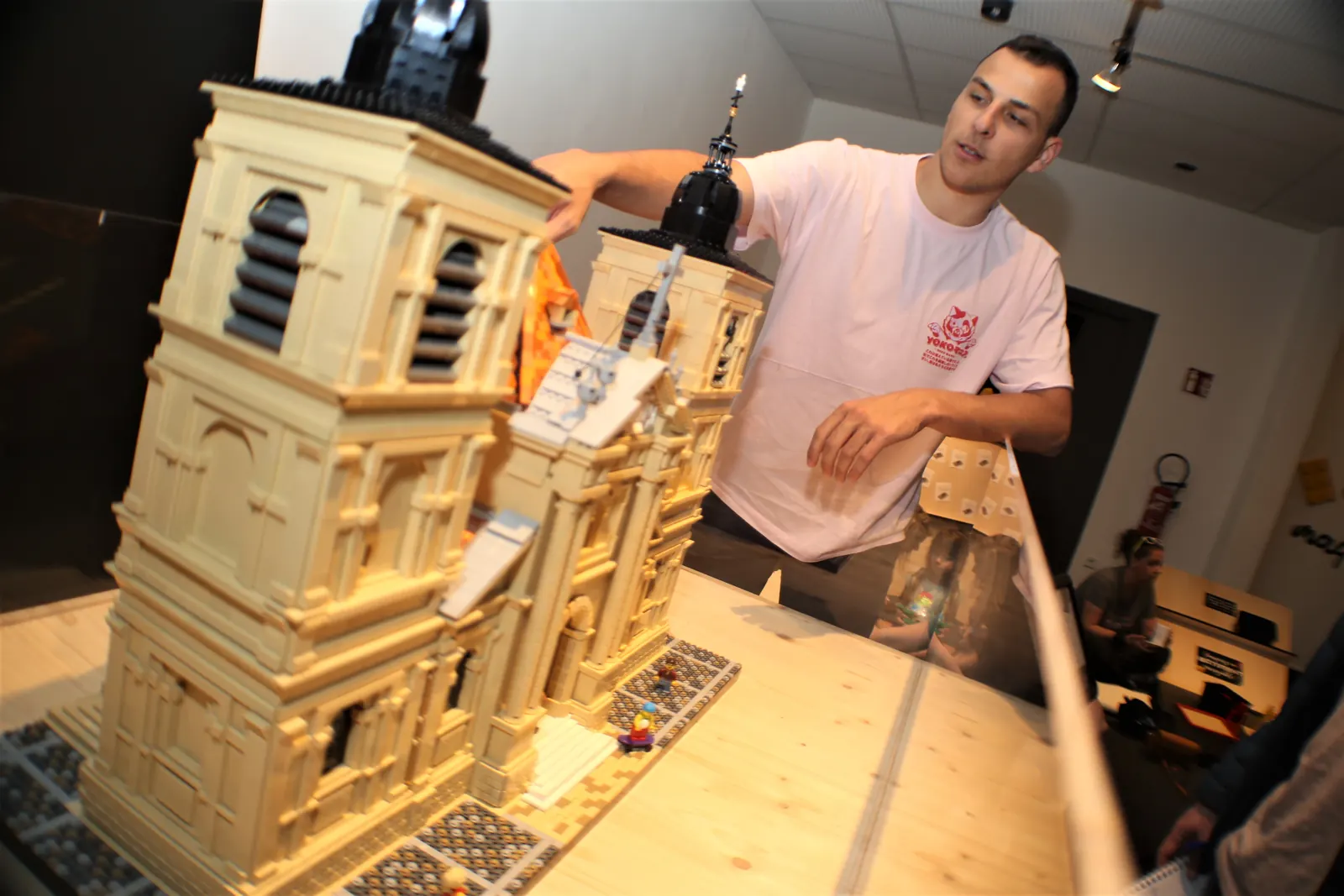
Montage des tours de la cathédrale de Saint-Dié en briques
Le montage à l'atelierPuis le transport, et l'installation sur place
Close view of the Roman city brick model
Client story

Lugdu'Briques — the Roman city at Lugdunum Museum

The museum wanted to make a vanished city tangible for family audiences, without a screen. We rebuilt the ancient quarter across 23 m²: the theatre, the odeon, the baths, the forum, the insulae. Every building was validated against archaeological surveys, and part of the construction was opened to the public during the exhibition.

  • ≈1,000,000pieces
  • 23 m²floor area
  • 6 monthsin the workshop

« The model lets us add a layer of information and understanding to subjects the museum covers. »

Arnaud GalliègueCultural interpreter — Lugdunum Museum, Lyon
Who commissions us

The people who trust us with a piece.

What our clients have in common: they have something to make understood, and words are no longer enough.

Museums & monuments

Permanent or temporary display, young-audience interpretation, accessibility. Often funded through patronage or an exhibition budget.

Developers & architects

Sales suite, property fair, reception lobby. A tool that outlives the sales campaign and ends up inside the finished building.

Local authorities

Making a territory, an industry or a planning project legible to residents, in public meetings as much as in exhibitions.

Companies & industry

Explaining a process, a site or a plant to visitors, clients or candidates, without taking them there.

What people ask before commissioning.

What does a model cost?

Four things drive the price: scale, level of detail, whether we build it or your audience does, and the deadline. Our rates are provided on request, within 24 to 48 working hours. We answer on feasibility and a broad range free of charge. Our rates are provided on request, within 24 to 48 working hours.

How long does it take?

Allow six to fourteen weeks for a building model, depending on size and detail. A monumental project runs from six months to a year. The limiting factor is not construction but sourcing: some rare parts take time to gather in quantity.

What do you need to start?

Plans, elevations and photographs are enough in most cases. For a historical reconstruction we work from your surveys, your scholarly publications and alongside your research team. If all you have is photographs, we can work with that too.

Is the model robust?

Yes. Parts are assembled using structural reinforcement techniques, and fragile elements are designed to be replaceable. For open-access display we offer selective bonding and a protected plinth. We also supply a spare-parts kit.

Can it travel and be shown elsewhere?

We design large models in demountable modules with bespoke flight cases. A touring piece has to be planned from the start: tell us at the first conversation, it changes how we build.

Can our audience help build it?

Yes, and we do it often. We design the model, then open part of it to your visitors, teams or partners, guided by our digital plans and supported by our hosts. The people who laid pieces come back to see the finished model, and bring others to see it.

Who owns the finished work?

You do, on delivery. We keep the right to photograph it and show it in our portfolio, unless otherwise agreed in writing — which we accept readily if your project is confidential.

Do you install on site?

Yes, and we recommend it for anything above two square metres. On-site assembly is included in the quote, along with levelling, any lighting, and training your team in routine care.

Let's talk

Describe the piece you have in mind.

A plan, a photograph, an intention: that is enough for us to tell you whether it can be done, at what cost and in how long.

Start a project

contact@unibrick.frAnswered within 24–48 working hours
+33 7 61 71 03 69Monday to Friday, 9am – 6pm CET
Workshop near LyonWe deliver and install across France